
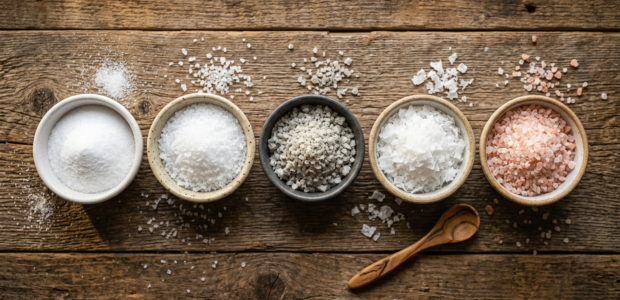
Walk down the salt aisle and it’s easy to feel a little overwhelmed. Table salt, kosher salt, sea salt, flake salt, pink Himalayan, fleur de sel, the list keeps going, and most of the labels don’t explain what actually makes one different from another.
Here’s the good news: once you understand a handful of basics, choosing the right salt stops being a guessing game. It comes down to three things, where the salt comes from, how big and shaped the crystals are, and what job you’re asking it to do. Here’s a clear breakdown of the most common types and where each one shines.
Table Salt: The Everyday Default
Table salt is what most people grew up with, and it’s still what fills the shaker in most kitchens. It’s mined from underground salt deposits, ground down into small, uniform grains, and usually treated with an anti caking agent so it pours freely instead of clumping. Many brands also add iodine, a practice that dates back to the 1920s when iodized salt helped prevent widespread iodine deficiency.
Because the crystals are so fine and consistent, table salt measures precisely and dissolves quickly, which makes it genuinely useful for baking, where accurate measurements matter more than they do in savory cooking. Its downside is flavor. A lot of cooks find it has a slightly sharp, almost metallic taste compared to less processed salts, especially when used generously.
Best for: baking and recipes where precise measurement matters.
Kosher Salt: The Workhorse of Savory Cooking
Kosher salt gets its name from its traditional use in the koshering process, drawing blood from meat according to Jewish dietary law, not from being certified kosher itself. Despite the name, it’s become the go to salt for professional and home cooks alike, mostly because of its texture.
The crystals are larger and more irregular than table salt, which makes it easy to pinch between your fingers and season food evenly by feel, a technique a lot of chefs rely on. It also tends to have a cleaner taste, since most kosher salt skips the additives and iodine found in table salt. One thing worth knowing: because the crystals are bigger, a teaspoon of kosher salt is not as salty as a teaspoon of table salt, so recipes that swap between the two usually need adjusting by about a quarter more kosher salt to match.
Best for: everyday cooking, seasoning meat, brining, and salting pasta water.
Sea Salt: Flavor From the Ocean
Sea salt is made by evaporating seawater until only the crystals remain, rather than being mined from underground deposits. Because it comes straight from the ocean, it often carries trace minerals that can add subtle flavor and, depending on the source, a slight variation in color.
Sea salt comes in a wide range of textures, from fine grains that work like table salt to large, delicate flakes best saved for finishing a dish. Fine sea salt is a solid everyday substitute for table salt, especially for bakers who want to skip the additives. Coarser and flakier sea salts, on the other hand, are usually better saved for the moment right before serving, since their texture and flavor are part of the appeal and get lost when stirred into a dish during cooking.
Best for: fine sea salt for everyday cooking and baking; coarser sea salt for finishing.
Flake Salt: Built for the Final Touch
Flake salt is its own category worth calling out on its own, since it behaves differently from every other type on this list. The crystals are thin, light, and irregularly shaped, almost like tiny shards, which means they dissolve quickly on the tongue and deliver a quick, bright pop of salinity right where they land.
Because of that texture, flake salt isn’t really meant for cooking into a dish. It’s a finishing salt, meant to be sprinkled on top of something just before it’s served: a seared steak, a slice of good bread and butter, a plate of roasted vegetables, even a batch of chocolate chip cookies fresh out of the oven. The crunch and the visual appeal are as much a part of the experience as the flavor itself.
Best for: finishing dishes right before serving, never for cooking into a recipe.
Fleur de Sel and Other Hand Harvested Finishing Salts
At the more delicate end of the spectrum sits fleur de sel, French for “flower of salt,” a hand harvested salt skimmed from the surface of coastal salt pans before it sinks. It’s prized for its light, moist texture and subtle flavor, and it commands a higher price because of how labor intensive it is to collect.
Other artisanal finishing salts, like flaky Maldon salt from England or the small batch flake salts harvested along the Oregon coast, fall into a similar category. These are salts meant to be noticed, not blended in, which is why they’re almost always used as a final touch rather than during cooking.
Best for: special occasion finishing, where texture and presentation matter as much as flavor.
Himalayan Pink Salt: More About Looks Than Chemistry
Himalayan pink salt is mined, not harvested from the sea, and gets its pale pink color from trace minerals like iron oxide. Despite popular claims, it isn’t meaningfully different in sodium content or health impact from other salts. Where it does shine is presentation, its color makes it a popular choice for finishing dishes or for salt blocks used in cooking and serving.
Best for: finishing and presentation, more than everyday cooking.
Pickling Salt: The Specialist
Pickling salt is a fine grained, refined salt made specifically for brining and pickling. Unlike table salt, it skips the anti caking agents entirely, since those additives can cloud a pickling brine or affect fermentation. It’s not a salt most people keep on hand unless they’re actively pickling or fermenting something.
Best for: brining and pickling, and little else.
A Simple Way to Decide Which Salt to Reach For
If the growing list of options feels like a lot to remember, it really comes down to one question: is this salt going into the dish while it cooks, or onto the dish right before it’s served?
- Cooking into a dish: table salt or kosher salt, depending on whether precision (baking) or feel (savory cooking) matters more.
- Finishing a dish: flake salt, fleur de sel, or a coarse sea salt, chosen mostly for texture and how it looks on the plate.
- A specific task: pickling salt for brining, Himalayan pink salt for presentation or a salt block.
Frequently Asked Questions
Is one type of salt actually healthier than another? Not meaningfully. Sodium content is similar across most salt types. The differences that matter most for everyday cooking are texture, flavor, and how each one is best used, not nutrition.
Can I substitute one salt for another in a recipe? Usually yes, but the amount needs adjusting. Because crystal size affects how much salt fits into a teaspoon, a coarser salt like kosher salt generally needs about a quarter more volume than table salt to match the same level of seasoning.
Why is flake salt more expensive than table salt? Flake and other artisanal finishing salts are typically produced in smaller batches through evaporation rather than mining, and the process is often more labor intensive, which is reflected in the price.
Do I really need more than one type of salt in my kitchen? Not strictly, but most cooks find it worthwhile to keep at least two on hand: a kosher or table salt for everyday cooking, and a good flake or sea salt for finishing dishes where texture and flavor matter more.