
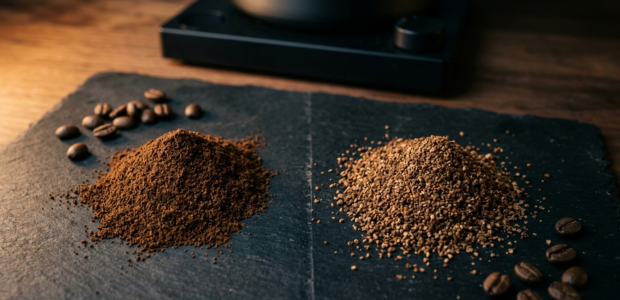
If you’ve ever brewed the exact same coffee two different ways and ended up with two completely different cups, grind size is almost always the reason. It’s the single biggest lever you have over how coffee tastes, more than the beans themselves in a lot of cases, and it’s also the one most people adjust the least.
The good news is that dialing in isn’t guesswork once you understand what’s actually happening. Here’s a clear breakdown of how grind size works, what espresso and filter coffee each actually need, and how to adjust with confidence instead of turning the dial randomly and hoping.
Why Grind Size Changes the Whole Cup
Grind size controls how much surface area your coffee exposes to water, and that surface area controls how fast extraction happens. Finer grounds expose more surface area, so water pulls flavor out quickly. Coarser grounds expose less, so extraction happens more slowly.
That’s why grind size has to match brew time. Espresso pushes hot water through coffee in roughly 25 to 30 seconds, under real pressure, so it needs a fine grind to extract enough flavor in that short window. Pour over and drip methods give water several minutes of contact time, so they need a coarser grind, or the coffee would over extract and turn bitter and harsh.
Get the grind wrong in either direction and you’ll taste it immediately. Too fine for the method, and coffee turns bitter, heavy, or harsh, since water can’t move through fast enough and pulls out more than it should. Too coarse, and coffee tastes sour, thin, or weak, since water races through without picking up enough flavor.
Espresso: The Finest, Least Forgiving Grind
Espresso sits at the fine end of the spectrum, close to the texture of fine table salt. This is the most demanding grind on the entire spectrum, because espresso gives you almost no room for error. A tiny adjustment, even a fraction of a turn on a grinder like the GU64 or GU38, can shift a shot from sour and thin to balanced, or from balanced straight into bitter and harsh.
A few signs your espresso grind needs adjusting:
- Shot pulls too fast (under 20 seconds): the grind is too coarse. Water is moving through the puck too quickly to extract properly, which usually tastes sour or weak.
- Shot pulls too slow (well past 35 seconds): the grind is too fine. Water is struggling to push through, which often tastes bitter or overly heavy.
- Shot looks right but tastes flat: sometimes the grind is fine, but the dose, tamp, or ratio needs attention instead. Grind size is the biggest lever, but it’s not the only one.
This is exactly why a grinder with fine, precise adjustment matters so much for espresso. A grinder that jumps in big steps between settings makes it nearly impossible to land in that narrow sweet spot, which is the whole reason flat burr and low speed conical designs, like the GU64’s stepless RPM control or the GU63’s low speed grinding, exist in the first place. Small, real adjustments are what let you actually find the setting instead of bracketing around it forever.
Filter and Pour Over: More Room to Breathe
Pour over and drip methods sit in the medium range, generally described as feeling like fine to regular beach sand, distinctly coarser than espresso and noticeably grainier to the touch. Because these methods rely on gravity and a longer brew window rather than pressure, they’re more forgiving than espresso, but grind size still matters plenty.
A few signs to watch for with pour over specifically:
- Brew finishes in under two minutes: the grind is probably too coarse, and the coffee is likely tasting thin or sour.
- Brew stalls past four minutes, or water pools on top: the grind is too fine, or too much fine dust is clogging the filter, which usually shows up as bitterness.
- Coffee tastes flat and one note: try grinding slightly finer to pull a bit more out of the coffee, then taste again before making a bigger change.
Drip machines behave a little differently than manual pour over, since most control their own contact time and can’t compensate for a grind that’s far off. A grind that makes excellent pour over can make flat, underwhelming drip coffee if you don’t adjust the setting when switching methods.
How to Judge Grind Size by Feel, Without Overthinking It
You don’t need a microscope to sanity check a grind. Rub a small pinch of grounds between your thumb and finger.
- Espresso should feel close to fine table salt, with a faint grit that clumps slightly under pressure.
- Pour over and drip should feel distinctly grainy, more like sand, with individual particles you can actually identify.
- French press, for comparison, feels noticeably chunkier and separates cleanly rather than clumping.
It also helps to look at grounds on a white surface. You want a population that looks fairly uniform. A mix of large visible chunks next to fine powder means the grind is uneven, and no amount of dial adjustment will fix that on its own, that’s usually a sign of a low quality grinder or worn burrs, which is part of why consistent burr geometry and low retention design matter so much for repeatable results.
A Simple Process for Dialing In
Whether you’re working with espresso or pour over, the process is the same, and it’s worth resisting the urge to change more than one thing at a time.
- Start in the right general range for your method (fine for espresso, medium for pour over and drip).
- Brew and taste. Pay attention to whether the cup feels sour and thin, or bitter and heavy.
- Adjust in one direction only. If it’s sour or the brew finished too fast, go finer. If it’s bitter, harsh, or the brew took too long, go coarser.
- Change one variable, then taste again. Resist adjusting grind, dose, and brew ratio all at once. You won’t know what actually fixed (or broke) the cup.
- Write down what works. Once you land on a good setting for a specific bean, note it down. Different beans, especially different roast levels, often need a slightly different setting even on the exact same grinder.
Why a Precision Grinder Actually Matters Here
A lot of the frustration people run into with dialing in isn’t really about technique, it’s about equipment that can’t hold a setting or adjust finely enough to find the right spot. A grinder with stepless adjustment and consistent RPM, like the GU64, gives you the range to move between fine espresso and coarser filter settings on one machine. A quieter, low speed conical grinder, like the GU63, tends to produce a more even particle distribution at lower heat, which matters more than people expect since heat from grinding can affect flavor too. And for anyone working with a smaller footprint, a compact single dose grinder like the GU38 or a portable option like the T38 Plus still needs that same fine, real adjustment range to dial in properly, size doesn’t excuse a grinder from doing this one job well.
Frequently Asked Questions
Why does the same grind setting taste different with a new bag of beans? Different beans, roast levels, and even how fresh the beans are can all shift how they extract at the same grind setting. It’s normal to need a small adjustment when you open a new bag, especially if the roast level or origin is different from what you were using before.
Should I change grind size or brew ratio first when a cup tastes off? Start with grind size, since it’s usually the bigger factor in whether coffee tastes sour, bitter, or balanced. Once the grind feels close, small ratio adjustments can fine tune the result from there.
Is a more expensive grinder really going to make a noticeable difference? Often yes, mainly because of consistency. A grinder that produces a more even particle size, without a mix of large chunks and fine dust, gives you a much more predictable cup, and makes the whole dialing in process faster since you’re not fighting inconsistent grounds on top of everything else.
How fine should espresso grind actually be compared to pour over? Espresso sits at the fine end of the spectrum, close to fine table salt, while pour over sits solidly in the medium range, closer to fine beach sand. It’s a real, noticeable difference in texture, not a subtle one.